Remember sitting in a quiet room, staring at a blackboard covered in long equations? You try to memorize why a tiny spark happens during a reaction. For many of us, high school science felt like a never-ending theory lesson mixed with formulas. But everything changes the very moment you leave your desk and walk into a fully equipped laboratory. Suddenly, a boring paragraph about chemical bonds becomes a bright green flame dancing inside a glass tube. You see it happen right before your eyes. That shift from reading words to watching reality is exactly what makes finding a good School in Nagpur or any other place so key for families today. When students get to mix the solutions themselves, science stops being a chore and becomes an actual adventure.
For the upcoming 2026-27 academic year, education is moving fast away from old-school memorization. No one wants kids to just repeat definitions anymore. The focus has completely shifted toward application-based learning, where students discover how things work through experimentation, mistakes and repeated practice. It is about building a deep curiosity that stays alive long after the final school bell rings. If you want your child to truly understand these ideas, first understanding the importance of CBSE science lab is the perfect place to start.
The Real Power and importance of CBSE science lab in Classrooms
Let’s look at it this way: reading a manual about how to ride a bicycle will never teach you how to balance on two wheels. You have to get on the bike, wobble a bit and feel how the steering works. Science functions the exact same way. When schools focus on regular experimentation, students develop a completely different relationship with their subjects. They are no longer passive observers listening to a lecture. They become active investigators.
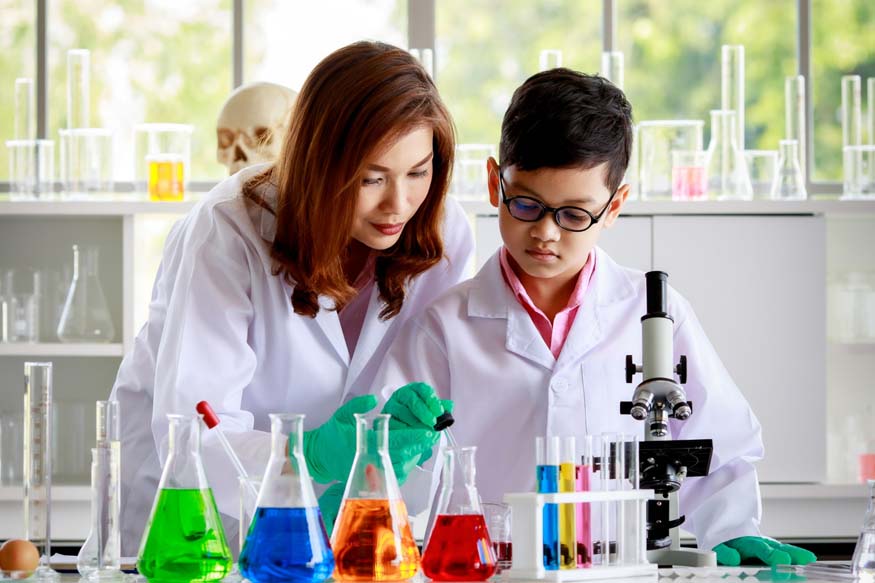
Working in a laboratory environment naturally sparks a sense of wonder that books cannot match. When a student adjusts the focus knobs on a microscope and suddenly spots the detailed wall of a plant cell, something clicks. That visual memory sticks around far longer than a line of text highlighted in yellow marker. This type of active engagement forms the foundation of experiential learning science across modern classrooms. It forces kids to use their eyes, hands and minds all at once.
You might notice how children who struggle to stay focused during a long reading session suddenly come alive in a laboratory. They enjoy measuring liquids, timing swings of a pendulum or connecting electrical circuits. These activities require constant attention and teamwork. By working in small groups, classmates talk through problems together. They argue about why an experiment did not give the expected result, check their steps and learn how to troubleshoot errors. Those moments of confusion and discovery build genuine critical thinking skills that help in every area of life.
Finding the Balance in Modern Education
There is an old debate among parents and teachers about what matters more: textbook knowledge or hands-on skills. In reality, they are two sides of the same coin. Theory provides the map, but laboratory work is the actual journey. A student needs to understand basic principles from their books before they can safely handle materials or interpret what happens during an experiment. However, relying solely on written exams creates a major gap in a child’s true understanding.
The way we evaluate students is shifting to reflect this balance. The traditional division between practical vs theory marks shows that education boards value both types of learning. Written exams check if you know the core concepts and vocabulary, while laboratory assessments test if you can apply that knowledge under real conditions. It prevents students from simply memorizing answers the night before a test without understanding the underlying concepts.
When you look at the modern CBSE School Curriculum, you see a deliberate effort to blend these elements smoothly. Laboratory sessions are not just a weekly break from regular classes but they are woven directly into the core academic plan. What is taught in the morning classroom is tested in the afternoon laboratory. This structure ensures that internal assessments look at a student’s total ability rather than just their memory retention. It creates a much fairer grading system for kids who might freeze during big written tests but shine when showing their skills with actual apparatus.
Modern Facility Standards and Evolving Trends
The world is moving fast and school laboratories are changing right along with it. Safety standards, equipment quality and teaching methods are completely different today than they were even five years ago. The introduction of the new science lab guidelines 2026 has brought a fresh wave of updates designed to make student spaces safer, more interactive and highly efficient.
Here’s something interesting: modern school laboratories are no longer just rows of dusty tables and glass jars. Today’s spaces use smart digital tools alongside traditional tools. For example, many advanced schools now use digital models to show experiments that might be too dangerous or complex to perform with raw chemicals. Students can use a tablet to simulate molecular reactions at an atomic level before stepping up to the actual workbench. This mixed method gives children the best of both worlds i.e. Physical handling of materials and high-tech visualization.
The latest rules also focus on environmental responsibility and safety. Modern setups use micro-scaling methods, meaning experiments use tiny amounts of chemicals to cut down waste and reduce fumes. Proper ventilation, emergency eyewash stations and clear safety protocols are required. Furthermore, there is a major push toward student-led project work. Instead of just following a strict recipe from a manual, students are encouraged to design their own simple experiments to answer specific questions. This method turns standard lessons into exciting open-ended investigations.
How Institutions Foster Scientific Thinking
Choosing the right educational environment plays a massive role in how a child views the world of discovery. A school that invests heavily in spacious, well-lit and safe laboratory spaces is investing directly in your child’s intellectual future. When searching for a Top School in Nagpur, parents should always look past the front lobby and check the spaces where children actually do work. The quality of these labs tells you everything you need to know about an institution’s teaching philosophy.
In vibrant neighbourhoods, finding a good School in Wardhaman Nagar means looking for places that make science feel easy to use and exciting. It is about creating an environment where a student feels safe to ask “why” and “what if” every single day. Experienced teachers do not just give out answers they also guide students through the process of discovering those answers on their own. They show kids how to collect data carefully, draw graphs based on real observations and accept when an experiment proves their initial hypothesis wrong.
A forward-thinking educational institute understands that the skills built in a chemistry or physics room extend far beyond earning high scores. These spaces teach children patience, precision and respect for facts. Whether a student grows up to be a researcher, an engineer or a business owner, the ability to look at evidence objectively is a superpower. By providing top-tier labs, local institutions give young minds the tools they need to build confidence in their own logical choices.
The True Edge of Centre Point School
When it comes to giving students a balanced, future-ready education, Centre Point School stands out as a true leader in the region. Known widely for its excellent academic standards and all-around development activities, the institution ensures that practical discovery is never left on the back burner. The campus features state-of-the-art physics, chemistry and biology laboratories designed to meet the highest safety and educational benchmarks. By blending a solid academic approach with hands-on learning experiences, the school helps young minds to explore complex scientific ideas with absolute confidence and joy.
Frequently Asked Questions
Why are hands-on experiments so important for young students?
Hands-on activities turn abstract ideas into real, physical experiences. They help students retain information much longer because the learning process involves multiple senses, teamwork and active problem-solving rather than simple memorization.
How does the current CBSE framework support practical training?
The modern system assigns specific weight to internal assessments and laboratory work. This ensures that a student’s final grades reflect both book knowledge and their physical ability to conduct experiments and analyse data accurately.
What safety measures should parents look for in a school laboratory?
Parents should look for clear safety signs, well-maintained protective gear like goggles and coats, modern ventilation systems, accessible emergency exits, eyewash stations and continuous supervision by qualified staff members.
Can digital simulations replace real physical experiments?
While digital tools are excellent for visualizing complex or dangerous concepts, they cannot replace the hands-on learning that comes from handling real equipment, measuring physical substances and managing real-world variables.